
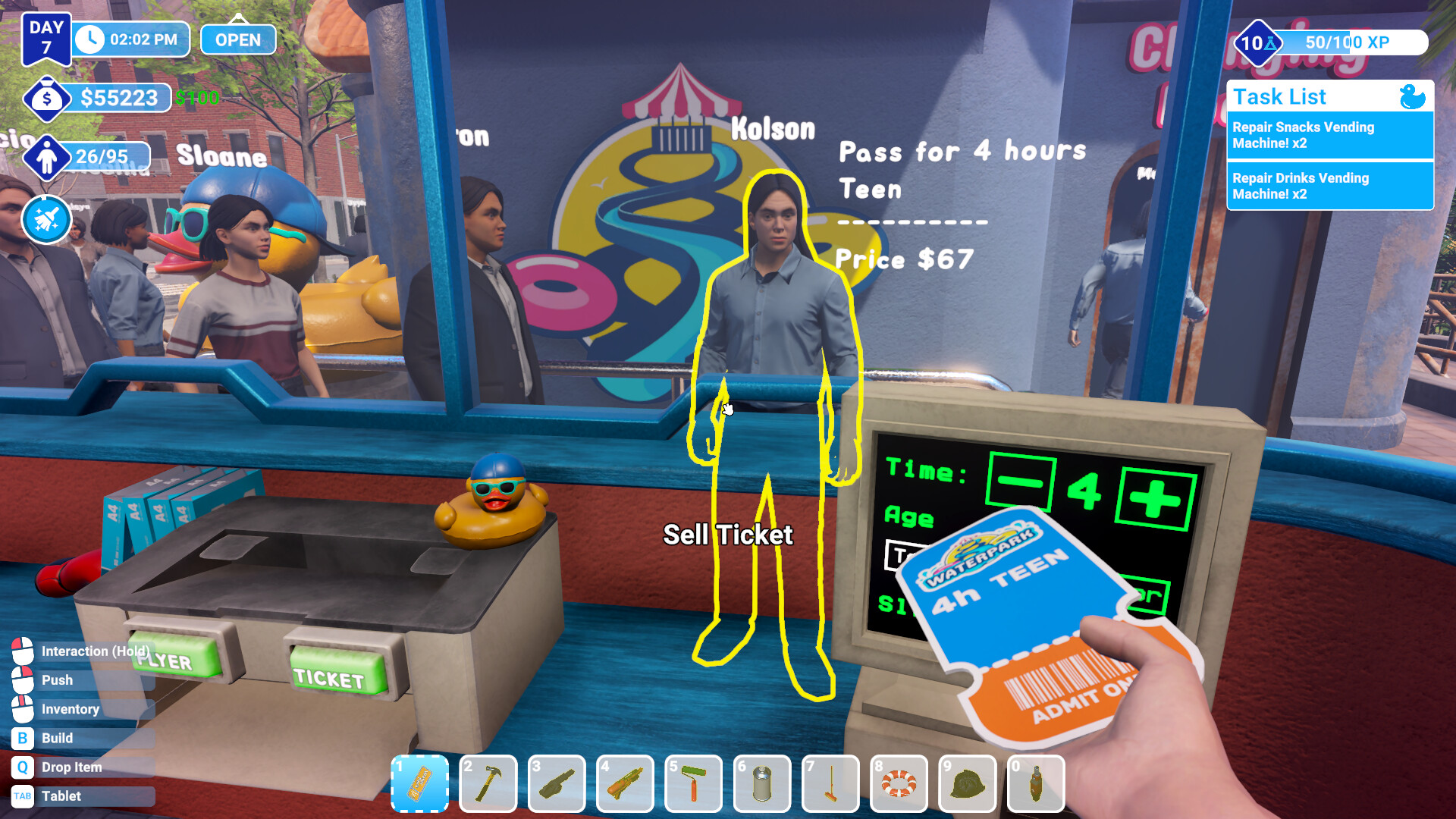
Manage the park as one visible operating loop
Waterpark Simulator does not separate construction from operation at the point where the player experiences the park. Slides and pools create the physical attraction network, while tickets and food create guest-facing service. Cleaning, repairs, and rescues require direct attention. Staff add role-based support. Guest happiness and the park rating then reflect how those layers work together. A management plan should preserve that visibility instead of reducing the park to a single abstract score.
Begin each review with the current problem, not with the next object you want to buy or build. If the area is dirty, treat cleanliness as the operating lane. If the attraction is weak, inspect slide fun and the build context. If service is failing, look at food quality and the guest-facing layer. If visitors are unhappy, trace the broader experience. The official material names the categories but does not provide a complete public formula, so the page uses them as inspection headings rather than invented percentages.
Legibility is a management resource. From the first-person viewpoint, the player must move through the park to see and address work. Clear paths between attractions, service points, and problem areas make direct action easier to understand. The sources do not publish an optimal grid or staffing geometry, but they support a simple rule: do not let expansion erase the ability to operate what already exists.
- Identify the visible problem and assign it to construction, service, maintenance, staff, or rating review.
- Complete the direct work that restores the current operation.
- Check the four named rating inputs separately.
- Use staff categories for their confirmed purpose rather than a fabricated universal tier.
- Expand only after the current park remains readable from ground level.
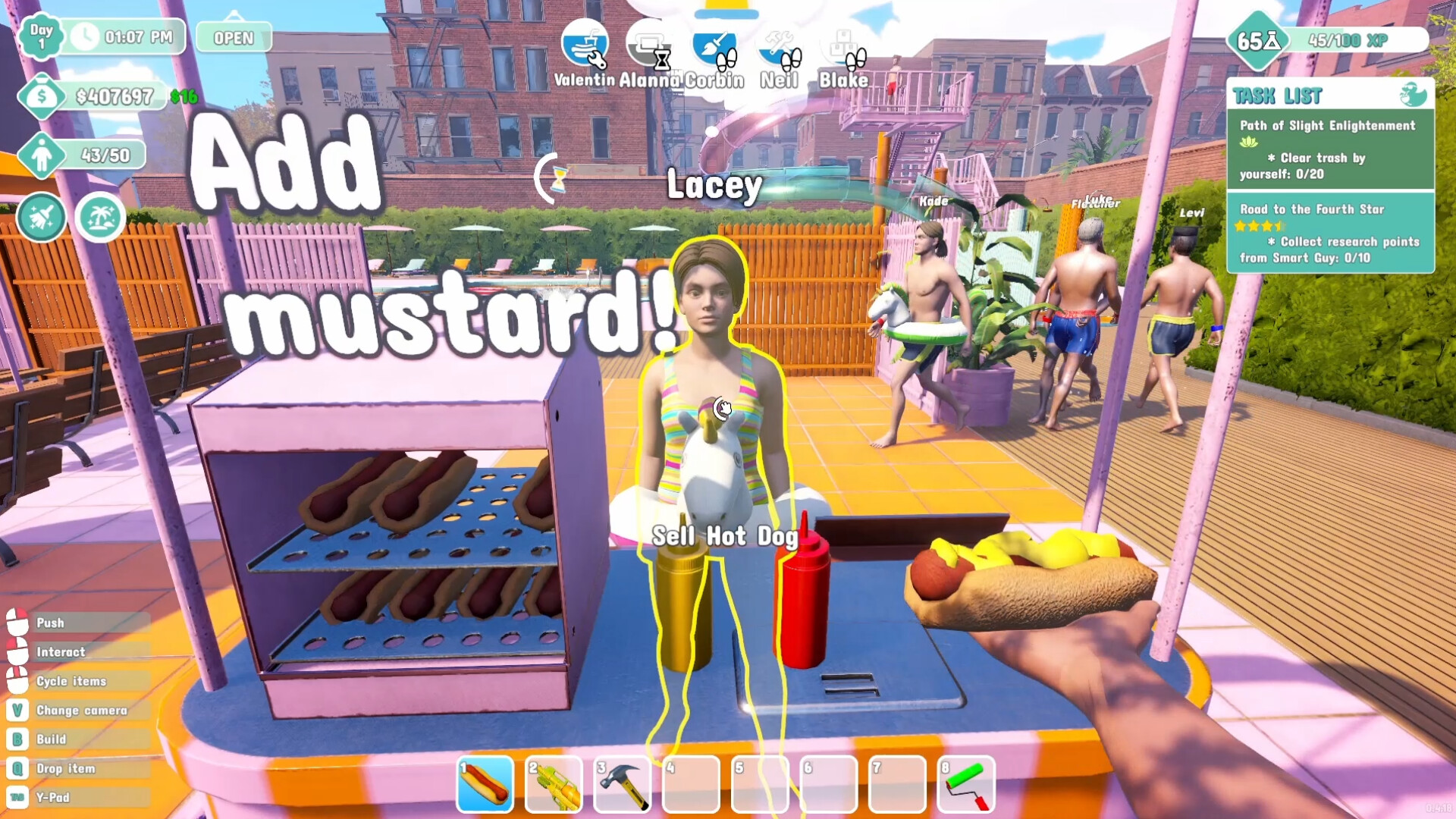
Use four rating inputs as separate inspection lanes
Cleanliness, slide fun, food quality, and guest happiness are the named inputs to the park rating. They form a useful operating board because each points toward a different kind of work. Cleanliness connects to the condition of the park and direct cleaning. Slide fun connects to the attraction experience. Food quality connects to guest-facing service. Happiness is the broad visitor outcome that can reveal whether the park’s parts are working together.
Inspecting them separately prevents a common error: treating a new attraction as the answer to every slowdown. A park can have a memorable slide while still losing ground through poor cleanliness or food. It can be clean while offering an underdeveloped attraction mix. The categories interact, but the distinction helps you choose the next action and evaluate whether that action addressed the problem you intended to solve.
The official version 1.0 language points toward a diamond five-star park. It does not give this handoff a complete threshold table, so the guide will not assign exact values to star levels. Use the five-star target as a progression direction. Compare the visible park before and after a change, keep the four inputs in view, and avoid making several unrelated adjustments at once when you are trying to learn which layer mattered.
| Input | Operating question | Related work |
|---|---|---|
| Cleanliness | Is the park condition receiving enough direct attention? | Cleaning and readable access |
| Slide fun | Does the attraction mix give visitors a strong slide experience? | Slides, pools, and build review |
| Food quality | Is the guest-facing food layer keeping pace with the park? | Food service and operating support |
| Guest happiness | Does the combined park experience remain healthy? | Attractions, service, staff, and condition |
| Five-star direction | Can the current operation support the next improvement? | Park-wide progression without invented thresholds |
Assign staff categories by their confirmed purpose
- Visitor control
- Security
- Amusement and happiness
- Mascots
- Hireable team members
- Star Staff
Removes bad visitors.
Supports the guest experience.
A team-member character category.
Version 1.0 names Security and Mascots as staff types and describes Star Staff as hireable team-member characters. Security removes bad visitors, placing that role in visitor control. Mascots increase amusement and guest happiness, connecting them to the experience layer. Star Staff belong to the hireable team structure. These purpose statements support operational decisions without supporting a universal price list or performance ranking.
Use the problem to choose the category. A visitor-control issue is not the same as a happiness issue, even though both may involve staff. A Star Staff decision belongs to team composition, but the official announcement does not provide enough data in this handoff to rank named individuals or publish exact efficiencies. The Characters & Staff directory therefore keeps role fields compact and sends management questions back to this broader operating context.
Staff support does not erase hands-on work. The official core loop continues to include cleaning, repairs, rescues, food, tickets, and construction. Read each staff category as one tool inside that loop. If the park’s routes are difficult to navigate or the operating responsibilities have grown beyond what the layout can support, adding a category cannot substitute for making the park readable again.
Plan for night operation and weather modifiers
Version 1.0 adds night operation and weather types. The official announcement states that night changes employee pay and cheater behavior, while weather can apply bonuses or penalties. Those facts make time and conditions part of the management picture. They do not justify a table of exact multipliers that the source does not publish, so the useful response is to review the park’s workload and risks whenever the operating context changes.
At night, staff cost and visitor-control concerns deserve attention because employee pay and cheater behavior are explicitly affected. Security therefore has a clear relationship to the night context, while the rest of the park still needs food, cleaning, repairs, rescues, and guest experience support. Treat the shift as a changed operating state, not as a cosmetic lighting effect.
Weather bonuses or penalties can make the same park behave differently across sessions. Before expanding during favorable conditions, ask whether the underlying operation would remain readable when the modifier changes. During a penalty, prioritize the responsibilities the park is visibly asking for rather than assuming that every condition has one fixed answer. The exact live effect belongs to the current interface and version; the management principle is to keep capacity and service aligned with the conditions you can observe.
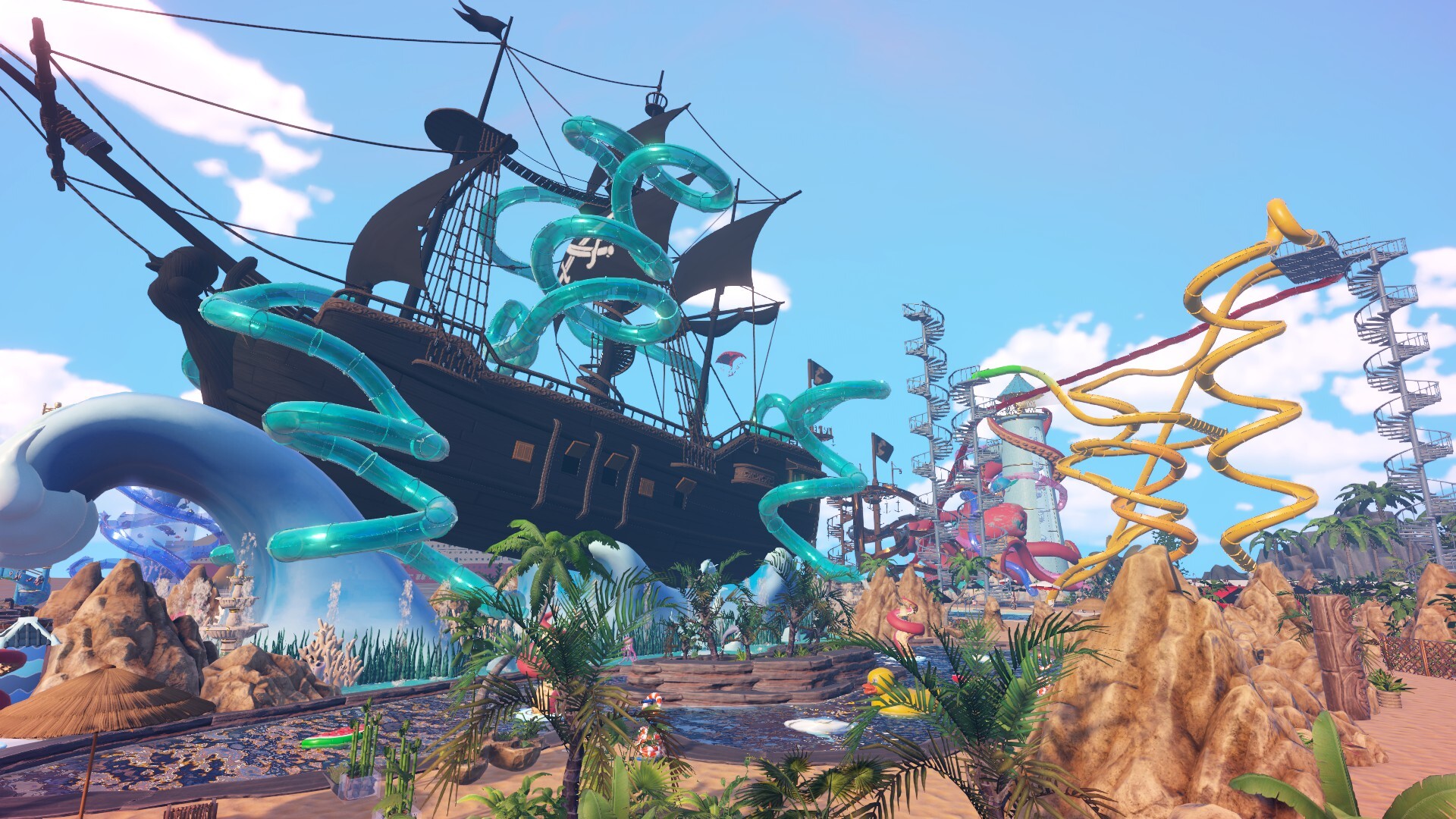
Grow toward five stars without outrunning the operation
The diamond five-star target gives the park a long-term direction, but growth should remain tied to operating readiness. Before adding another attraction, confirm that the current slides and pools are usable, direct work remains reachable, food and tickets fit the guest flow, staff roles address real problems, and the four rating inputs can be inspected without guessing. Expansion is strongest when it adds a clear purpose to a stable structure.
Research can support that growth through the museum’s three NPC roles, three currencies, and three branches. Aztec, Sea, and Pirate are the named version 1.0 themes. Use a research objective to shape the next area, but do not assume an unpublished cost or performance bonus. The Research reference records the verified branch structure while the live game supplies the current node details.
Multiplayer can distribute the workload among four total players, yet more hands do not automatically create a better plan. Shared sessions still benefit from visible task ownership and a readable park. Whether you operate alone or with up to three other people, the same management board applies: understand the current problem, act on the relevant layer, check the four inputs, and expand only when the result remains manageable from the first-person viewpoint.
- Current attractions and service routes remain readable.
- Cleaning, repairs, rescues, food, and tickets are receiving visible attention.
- Staff categories match the problem they are intended to address.
- Night or weather conditions are included in the current workload review.
- The next research or build objective adds a distinct purpose to the park.
Frequently asked questions
What affects the park rating?
The official sources name cleanliness, slide fun, food quality, and guest happiness as rating inputs, with version 1.0 pointing toward a diamond five-star park. The handoff does not contain a complete numeric threshold table, so use the four inputs as separate inspection lanes rather than guessed percentages.
What do Security and Mascots do?
Security removes bad visitors, placing the staff type in visitor control. Mascots increase amusement and guest happiness, connecting them to the experience layer. Version 1.0 also describes Star Staff as hireable team-member characters. Exact costs and efficiencies are not published here without version-bound evidence.
How do night and weather change management?
The version 1.0 announcement states that night affects employee pay and cheater behavior, while weather types apply bonuses or penalties. Review staff, visitor control, service, and maintenance whenever conditions change. The official handoff does not supply exact multipliers, so the live interface remains the source for current values.