
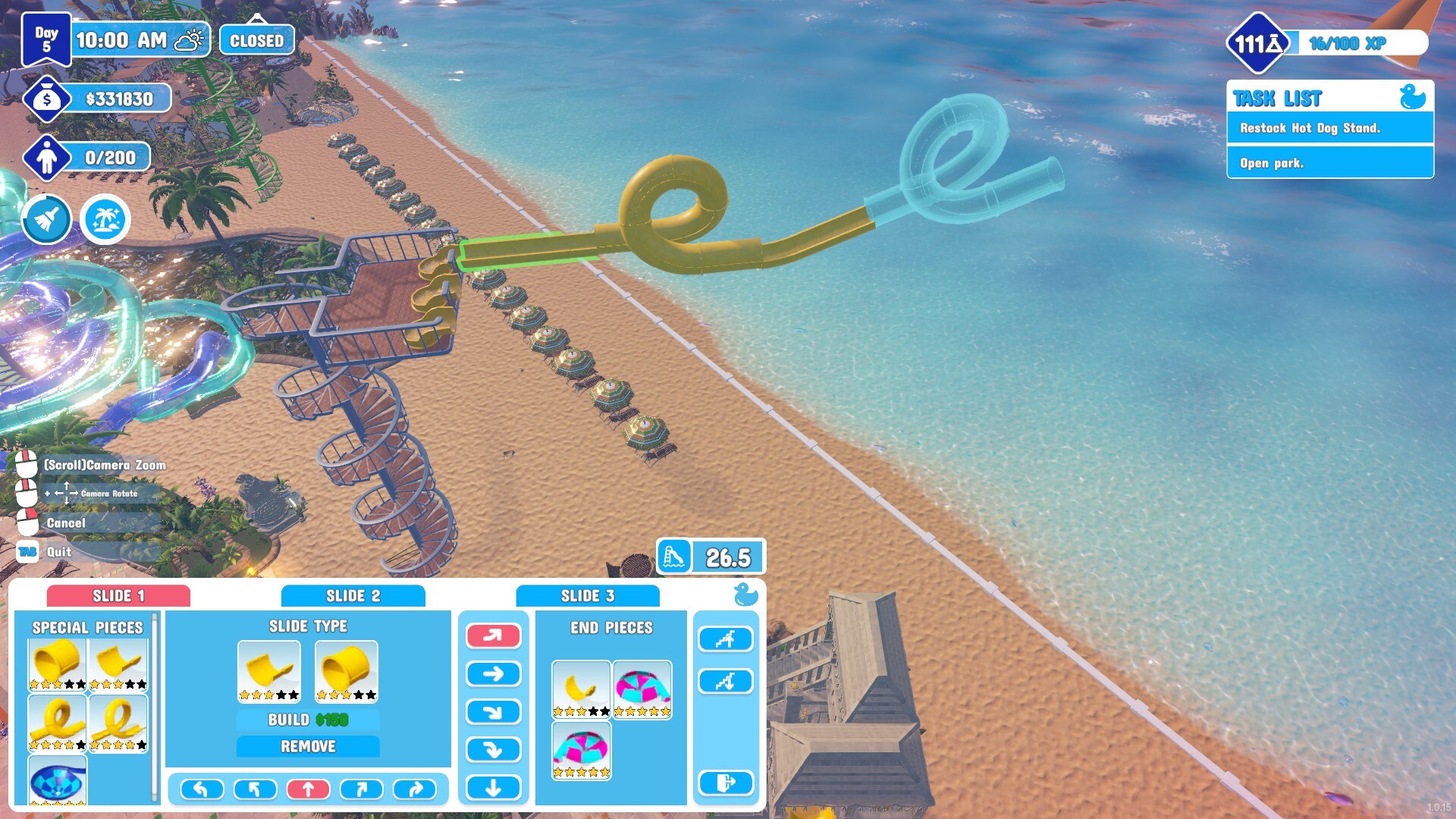
Read the core loop before placing the next attraction
The park loop begins with physical capacity: slides, pools, and the spaces around them. Construction creates the attraction, but the official description places food, cleaning, repairs, rescues, staff, and guest happiness in the same management frame. That means a usable build is not simply a dramatic slide. It is a park that gives the player room to see problems, reach the work, and continue operating while visitors move through the attraction network.
Treat the early park as a sequence of observable questions. Can visitors reach and use the attractions you built? Can the player reach service points and problem areas without turning every response into a long detour? Are cleanliness and food quality receiving attention while slide fun grows? The official sources name those categories but do not disclose a perfect spacing formula, so the reliable method is to preserve a legible layout and respond to visible conditions instead of copying an unsupported blueprint.
The table below is a responsibility map, not a hidden scoring table. It keeps the player’s action attached to the confirmed system that action serves. When a park stalls, use it to identify the layer that is missing: physical attraction work, direct maintenance, guest-facing service, staff support, research progression, or multiplayer coordination.
| Player task | Confirmed scope | Use this guide |
|---|---|---|
| Build attractions | Create slides and pools; custom slides include player-built layouts shown with loops and spirals. | Slides & Building |
| Serve visitors | Sell tickets and food while monitoring the quality of the guest-facing operation. | Park Management |
| Keep the park usable | Clean, repair equipment, and rescue visitors through direct first-person work. | Park Management |
| Grow progression | Use the museum’s three NPC roles, three currencies, and three research branches. | Research & Unlocks |
| Share the work | Play with as many as three additional people and optionally use proximity voice chat. | Multiplayer Guide |
Use a practical first-session order
Start by reading the available space before adding complexity. Choose where the first attractions, movement routes, and service work can coexist, then build a small usable mix of pools and slides. The goal is not to predict every later expansion. It is to make the current park understandable from the first-person viewpoint, because that is where cleaning, repair, rescue, and guest-facing work are actually performed.
Open the park loop only as far as you can observe it. Watch how construction and direct service responsibilities begin to overlap. Add food and ticket work, keep the park clean, respond to damaged or unsafe conditions, and use staff where the game provides a role for them. When the park rating changes, inspect the named categories separately instead of assuming that every slowdown demands a new attraction.
Research and multiplayer are deliberate layers rather than substitutes for a stable park. The museum’s three branches organize unlock progression; multiplayer lets four total players share a session. Add either layer when it helps the current objective. A co-op group still needs a coherent attraction plan, and research still feeds a park that must be operated on the ground.
- Survey the space and reserve readable routes between attractions and service work.
- Build a usable pool-and-slide mix before expanding into a more complex custom slide.
- Begin the guest-facing loop with tickets, food, cleaning, repairs, rescues, and staff attention.
- Read cleanliness, slide fun, food quality, and guest happiness as separate rating inputs.
- Add museum research or multiplayer when the current park can support the added objective.
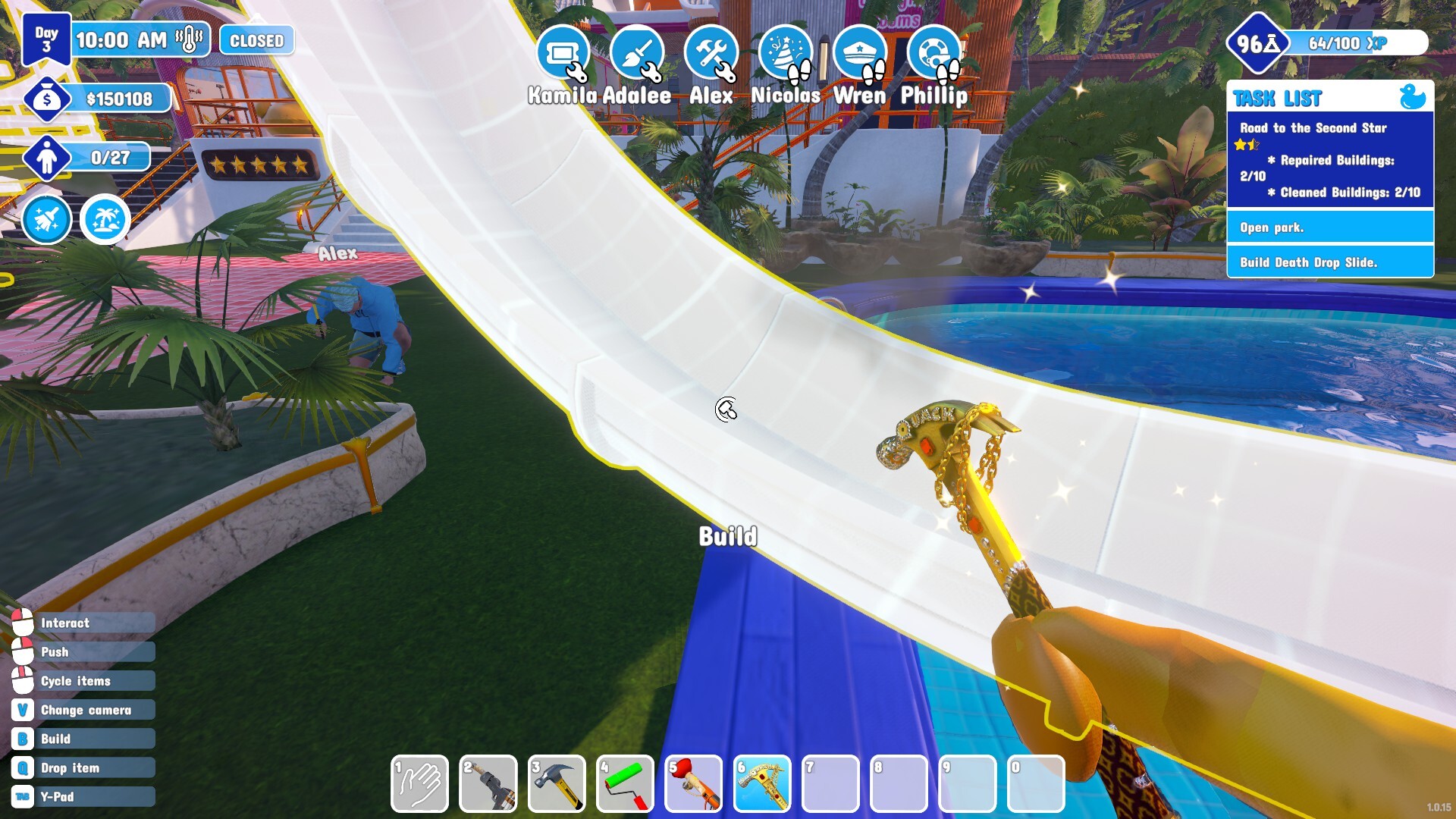
Use the park rating as a four-part inspection
The official game description ties the park rating to cleanliness, slide fun, food quality, and guest happiness. Those inputs give you a better troubleshooting order than a single vague “make the park better” command. If the rating stops improving, inspect the categories one at a time. A park can contain an entertaining slide while still suffering from poor cleanliness or weak food service, so attraction expansion should not automatically be the first response.
Cleanliness points toward the condition of the park and the direct work required to maintain it. Slide fun points back to the attraction mix and the experience those builds provide. Food quality belongs to the service layer rather than the ride layer. Guest happiness is the broad outcome that can reflect how the whole operation feels. The categories interact, but naming them separately prevents one visible success from hiding another neglected responsibility.
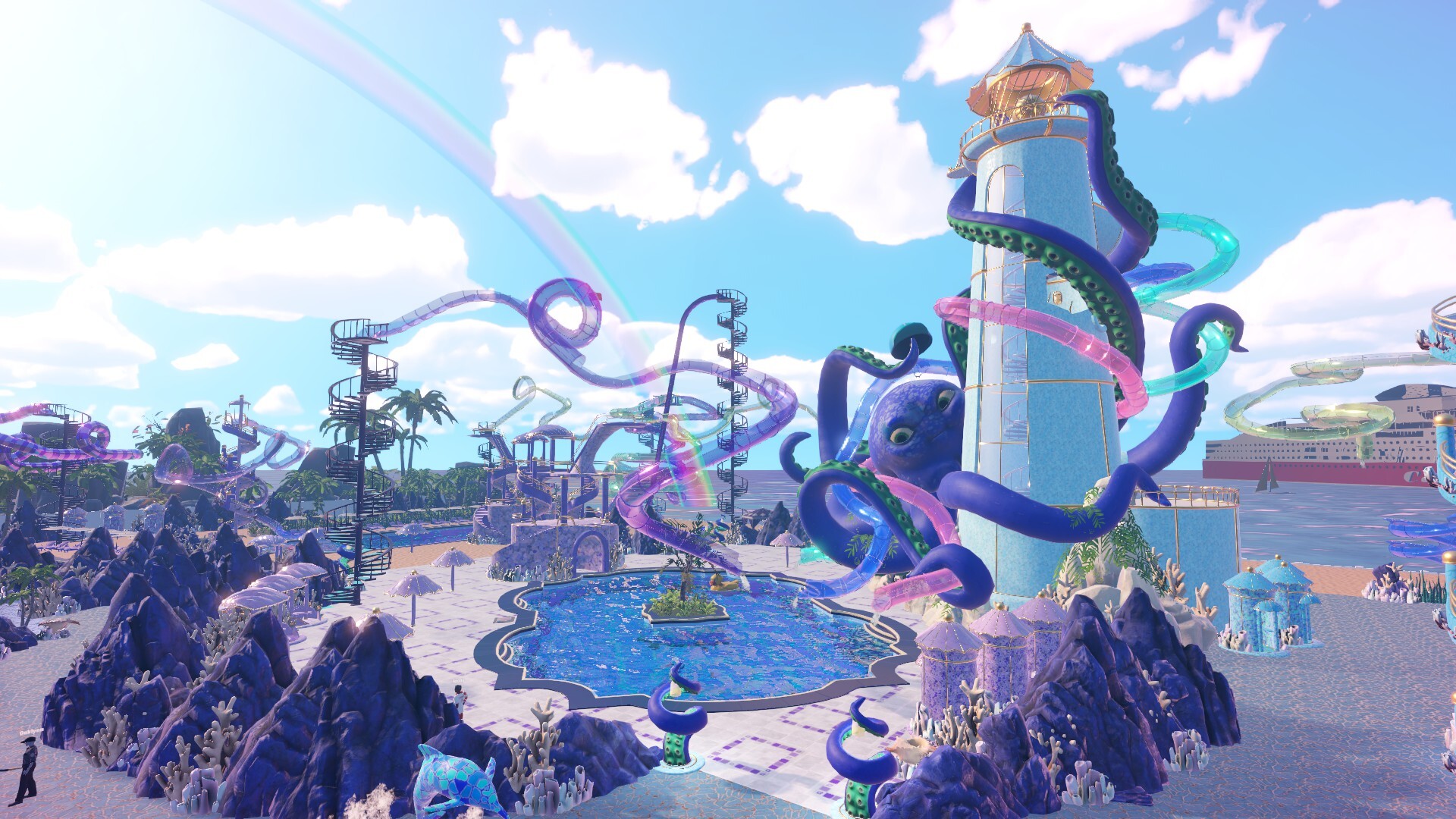
Version 1.0 describes progression toward a diamond five-star park. This walkthrough uses that goal as a long-term direction, not as permission to invent star thresholds. Record what changed in the park, compare it with the four named inputs, and adjust the relevant layer. That method remains useful even when updates change exact values, because it is anchored to the confirmed structure rather than a guessed formula.
Connect unlock progression to the museum
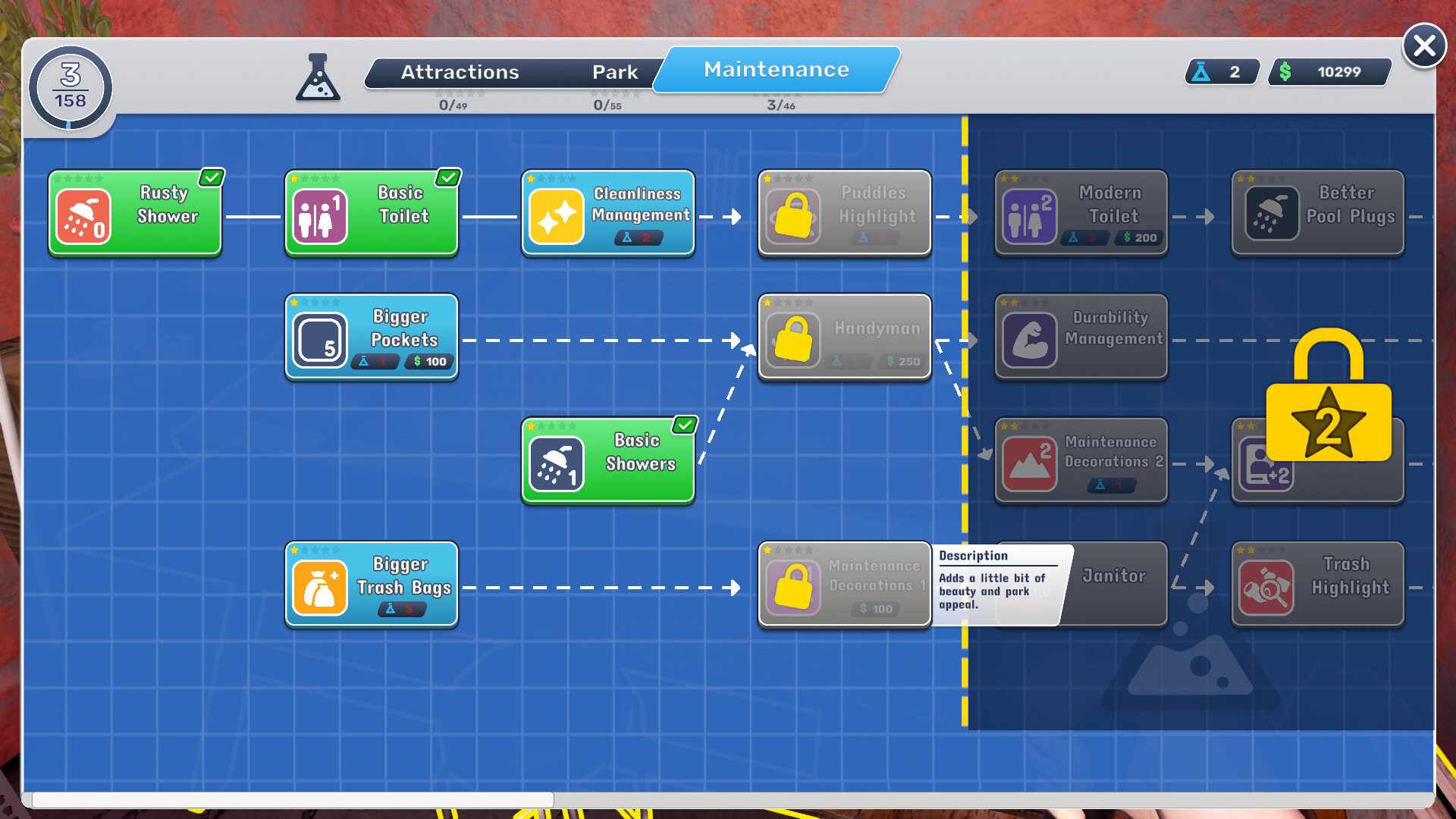
The museum gives research a concrete organizational center. Version 1.0 identifies three quest-giving NPCs, three separate currencies, and three branches of the research tree. Each NPC role connects to its own currency and branch. That structure is enough to plan a research session without inventing personal names, costs, or unlock conditions that are absent from the reviewed source material.
Use the three-branch model to keep objectives distinct. When you are pursuing research, note which museum role and currency belong to the branch you are advancing, then return to the park with a specific build or operations goal. The version 1.0 announcement also names Aztec, Sea, and Pirate as research themes, giving the unlock system a clear thematic direction while leaving exact node requirements to the live interface.
Research should support the park rather than obscure its current needs. If cleanliness, food quality, repairs, or guest happiness require immediate attention, complete that operating work before treating another unlock as the only path forward. The research tree expands options; it does not remove the first-person responsibilities that keep those options usable after they are built.
| Element | Verified count | Practical reading |
|---|---|---|
| Quest-giving NPC roles | 3 | Each role connects to a separate research path. |
| Research currencies | 3 | Each branch uses its own associated currency. |
| Research-tree branches | 3 | Keep objectives grouped by branch rather than mixing unsupported costs. |
| Version 1.0 themes | Aztec, Sea, Pirate | Use the named themes as the confirmed launch-era thematic set. |
Add multiplayer without losing task ownership
- Total players
- 4
- Proximity voice
- Optional
Host plus up to three additional players.
Available as a communication layer in version 1.0.
Version 1.0 allows the player to join with up to three friends or strangers, creating a four-player park session. Optional proximity voice chat adds a communication choice. Neither feature changes the underlying responsibilities described in the walkthrough: attractions still need to be built, the park still needs food and tickets, direct work still includes cleaning, repairs, and rescues, and the rating still reflects the named quality areas.
Before starting a shared session, agree on a small number of visible responsibilities. One person can focus on construction while another watches service and maintenance, but those roles should remain flexible because the park is experienced from the ground. Proximity voice can make nearby coordination natural; groups that do not want it can leave the feature optional and use their usual communication method.
The safest co-op expansion rule is the same as the single-player rule: grow only when the current operation remains readable. Four people can complete more work, yet additional builders can also make the layout harder to understand if everyone changes the park without a shared plan. Use the same four rating inputs as a common inspection vocabulary so the team can describe what needs attention without relying on an undocumented meta.
Official Waterpark Simulator version 1.0 trailer
Frequently asked questions
Is there one best opening layout?
The reviewed official material does not publish a universal optimal layout. Start with a legible attraction-and-service plan that you can operate from the first-person viewpoint, then expand after observing cleanliness, slide fun, food quality, guest happiness, maintenance work, and visitor movement in the current park.
What should I check when the park rating stops improving?
Inspect the four named inputs separately: cleanliness, slide fun, food quality, and guest happiness. A strong result in one category does not guarantee that the others are healthy. The official sources confirm the categories and five-star direction but not a complete numeric threshold table.
When should I start research or multiplayer?
Use either layer when the existing park can support it. The museum organizes three NPC roles, currencies, and branches; multiplayer adds up to three other people. Neither removes the need to build readable attractions and keep tickets, food, cleaning, repairs, rescues, staff, and happiness under control.